
Community Centric versus Donor Centric Fundraising
- Leigh Sandison
- May 13
- 10 min read

When I first started digging into community centric fundraising and learning what it was all about I loved it. Yes - limit the grovelling. Yes - don’t do things just because a large donor wants it. The idea generally is to build up the entire community not just specific donors, not just specific organizations.
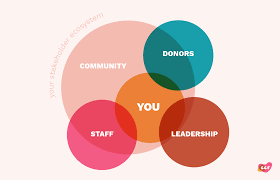
Info on community centric fundraising here: https://communitycentricfundraising.org/
Then I started thinking about the contrast of community centricity with donor centricity. And I thought ‘Oh no, am I a relic of the past?’ I love helping organizations learn more about their donors and using that knowledge to create better donor experiences. Is being donor centric bad? Should I not be thinking in this way? (Let it be known we are generally thinking in terms of ‘supporter-centricity’ because we’re about understanding supporters of all kinds - volunteers, members, advocates, donors, program users, stakeholders of all kinds).
So I thought I would break it down principle by principle and see how community centric and donor centric fundraising are different and where/if they converge.
I know my personal biases cloud my interpretation, just like all of us. I too am learning and am completely open to seeing each point in a totally different way (even happier to hear counterpoints over a virtual or real life tea).
The ten principles:
1. Fundraising must be grounded in race, equity, and social justice.
This first principle seems like the main reason for the Community Centric Fundraising philosophy at large. Fundraising is generally white and classist and it actively and continuously pushes the old narrative of generous rich white people helping poor BIPOC people.
If thinking about this in terms of donor centricity, I think of three things. The first, ‘diversifying donors’ - CCF mentions that we need to move beyond this to include the second, ‘encourage donors to think about’ things related to ‘race, equity, and social justice’. I may be misreading, but it feels like CCF alludes to the first point around diversifying donors as either standard now, or easy.
Having seen many small and mid sized organizations that are simply grateful to attract whichever donors they can, I would argue that the first is still not nearly where it should be. There is so much work that needs to be done from a diversifying donors perspective. One of the things we love doing at Real Path is helping organizations figure out who their ‘look-a-like donors’ might be. Not the donors you have now (who often fall into the rich, white, older category) but the supporters who resonate with your mission, and who are different ages, different races, different genders, different abilities, different everything. I feel like point one is not necessarily anti-donor centric, but it’s more like ‘individual centric’ or ‘potential donor centric’ and not ‘donors you already have centric’. (The above sentence made me realize my article writing skills are russttyyy - double negatives and over quoting. Thank you for bearing with me).
The second point ‘encourage donors to think about …. race, equity and social justice’ - is not secondary to the first point, nor dependent on the first point being in place. Organizations and fundraisers can and should do this right away (but it starts with doing it themselves, as individuals and collectively internally within an organization. Ready to start? I highly recommend https://anemochoryconsulting.com/ and the wonderful Anna-Liza Badaloo).
The third point around having fundraisers that connect to the community rather than the donor is a really important point in moving forward as a profession. Traditionally fundraising attracts a lot of white, female professionals. This can sometimes add to the imbalance of power with donor versus fundraiser especially when they are young females and donors are older, wealthy men, but the main issue is there has been a noticeable lack of representation from BIPOC folks and especially the communities served. How can someone who is not representative of the community represent the community? Answer: They can not. Especially not on their own.
In terms of donor-centricity and white female fundraisers, I suppose the question here is ‘is this because a white woman fundraiser is what the donor wants/expects’? Likely. For some donors (especially in high value circles) there is a lack of trust with fundraisers who don’t look, talk and act like the donors (ie white people with the same upbringing). And if you don’t have trust, you don’t get dollars.
I think this is the biggest conflict in community centric versus donor centric fundraising and is an area that I will be bringing to the forefront of my mind. If donors only give to people who look like them, are you valuing satisfying donors above equity by only having white fundraisers? Answer: Yes, you are choosing dollars over equity. You are also choosing a very short-sighted view of donor-centricity, putting your energy into who you think your donors are (from the past) and not who your donors could be.
2. Individual organizational missions are not as important as the collective community.
The donor versus community centric question here boils down to organizations failing to work together when a better outcome is possible with teamwork, if a donor’s gift is limiting to the collective betterment. Overall this one doesn’t feel anti-donor-centric but a different beast all together.
You can’t just keep your organization going because you have the funding to do it, you need to be truly adding value and not hindering the rest of the community with your impact.
The other side of this is if you SOLVE the problem, you should stop fundraising, congratulate everyone and move on to another problem. Never seeming to solve the issues is one of the most disheartening things about being in the non-profit space and also a major issue with getting the 83% * of Canadians who don’t donate (don’t claim charitable donations on their taxes) to contribute to solving problems.
This keeps me up at night.
3. Nonprofits are generous with and mutually supportive of one another.
I absolutely love this one. The scarcity mindset with respect to donors is not only bad, it’s also not correct. It is not the same as the corporate world of buying behaviour. Of all the regular donors I have spoken to, no one talks about deciding to donate with a ‘competitive set’ of potential charities, people give because they feel connected to a fundraiser, a cause, a campaign, a brand, in the moment (yes corporates and foundations are different in this respect).
If we can understand supporters, we can treat them with respect and we can feel assured they are with us because they understand and value our organization. We can feel comfortable propping up other NGOs because we feel secure in ourselves.
I must say, having worked with a few Canadian environmental non-profits, I am so impressed by the mutual respect, sharing and public (and private) collaboration I have seen. My hunch is that eNGOs and those who work for them are so desperate for change for our environment that helping each other feels like the only way to be. It’s inspiring.
4. All who engage in strengthening the community are equally valued, whether volunteer, staff, donor, or board member.
This is a major change, and puts a spear in the heart of donor-centricity in it’s original form because donor-centricity started with high value donors and high value donors alone. The rest of us, average folks, were not valued in the same way, and certainly the beneficiaries were not either. It was simple, money = value. No money = no value.
I LOVE the focus that every single supporter / community member / client is valued equally, deserves respect, and can contribute. This is such a core of community fundraising and shows that this movement really goes beyond fundraising - it’s ‘community building’.
Part of this is paying and treating staff properly to retain talent. A question that comes up from time to time with friends: Can you do more for non-profits by working in the for profit space and donating all the ‘extra’ you make, than by working in the non-profit space for pennies and killing yourself with limited support, budgets and staff? (My response is usually something like: do those ‘extra’ donations actually happen or do you just buy a bigger house?). The fact that this is a question totally stinks. We have to pay people fairly to do good work. We have to support them with good systems and staff and professional development.
5. Time is valued equally as money.
Time sadly seems to be valued the least and it’s the thing we can never make more of! One of the things Real Path does is supporter journey mapping and part of this is understanding when and how people are engaging as volunteers, advocates, donors and supporters in other ways. And then we find out how people actually want to be engaged in all those ways. This is the supporter centric part of it for us - talking to people, learning from people. One of the things we regularly find is that people want more opportunities to volunteer in ways that use their many skills. And it can be hard to create volunteering programming that is meaningfully tied to the organization. I have two suggestions here - 1. See #3 above, maybe there are related orgs that do it better and can create mutual benefit for both organizations and volunteers. 2. There are volunteer programming experts out there, talk to them, they know how to figure this out.
The twist here on donor-centricity is supporter-centricity. Supporters are all those who care about your org and provide value in different ways. Not just money.
6. We treat donors as partners, and this means that we are transparent, and occasionally have difficult conversations.
This is a toughie. We have been so trained to defer or silently nod and then figure out a way around a really out there donor ask. This makes me think of ‘the customer is always right’ mantra which is just so different in the for-profit world.
Fpr most of the projects we have worked on, the donors really just want to understand. They have to be taken on the journey, to get into the weeds. They want to be partners in success of the organization, not just patted on the head for donating. This is what they want from us.
Learning turns into depth of engagement, understanding of need and complexities and that turns into more volunteering, more campaigning, more donating and more advocacy. This is what we want from them.
Stepping into the truth can be scary, but everyone is so much better off for it. I actually think donor-centric and community-centric is 100% aligned here - I just think that we as fundraisers have been trained not to give people what they want (understanding) for fear of losing dollars. We need retraining, we need to be teachers instead of ‘yes men / yes people’).
7. We foster a sense of belonging, not othering.
The ‘we’ and the ‘you’. Having the donor be part of the ‘we’ of the organization just makes basic sense to me. “You, you, you have helped them, them, them.’ moves to ‘You are part of the we that is helping us.’. It’s not tightened marketing language, but it makes sesnse. More and more organizations are using ‘we’ language. However, I am not a part of high value donor conversations, so this might be an area where ‘you’ language and othering is still very much happening. Is it? I’d like to know.
8. We promote the understanding that everyone (donors, staff, funders, board members, volunteers) personally benefits from engaging in the work of social justice – it’s not just charity and compassion.
At first, this made me think of the question of selfless good deeds. But then I realized it’s actually the opposite of that. This is about showing people that helping others and building communities benefits everyone (even the ultra-rich). It’s not about being selfless at all. It’s about understanding the value of giving for everyone.
In this way I think that donor-centricity and community-centricity perfectly align here. It’s a reframing that centres donors within community and not outside of it looking in. This is a major shift in thinking, it’s the ‘be part of it’ rather than ‘help us’.
9. We see the work of social justice as holistic and transformative, not transactional.
This one speaks deeply to my heart. Since being a young fundraiser in the UK, I have balked at the idea of ‘overhead costs’ as a factor in giving. Corporates are valued so highly for making 10% profits and non-profits are totally disparaged for having less than 65% of income go to services.
Over the last few years, it does seem that more donors are getting more comfortable with donations that are ‘where the organization needs it most’. It’s heartening. Compared to 20 years ago when everything was about that pie graph of fundraising expenses to money spent on impact, I think there are more donors with more general understanding about how things work. I talked to a 60 yo donor a few months ago who said ‘Why aren’t they spending money on marketing? They need to spend money to make money’. I agree.
To me this could be anti-donor centric because the thinking is that donors won’t give to non-profits if their margins aren’t good. But I think that’s a huge old assumption about donor behaviours that needs to be validated. I think that we need to collectively change how non-profits are seen which goes into many of these other principles.
Getting supporters to see the overall value of what the organization is doing and not just programming money, fundraising money, marketing money, etc is the way forward. I really like that CCF is attempting to get all orgs to collectively avoid the bad habits of reporting tied to this old way of looking at spend, budgets and income.
10. We recognize that healing and liberation requires a commitment to economic justice.
This final principle is so enormous it’s difficult to consider in terms of donor centricity. The root causes of inequality are directly tied to capitalism which is how our donors have money to give. Under a different global economic and political system we might be in a different situation with more equality and more economic justice. We are not.
We are here with injustice and inequality everywhere, in every facet of our lives. This is why we need supporters to join us, to give, to volunteer, to advocate for change. To attempt to right all the wrongs. People who have, can and should give, so that people and communities who do not have can live.
Community Centric Fundraising acknowledges that it is ‘ever evolving’. In the process of developing and learning and thinking and growing. That is what we are all striving for - growth, forward movement, learning, bettering. These are the ten principles today, but they might not be tomorrow.
Overall this exercise of thinking about the principles of community-centric fundraising versus donor-centric and supporter-centric fundraising has led me to gain more clarity on community-centric fundraising. And has brought a few more BIG questions into my brain. I’m all for community-centric fundraising. I think we can engage our supporters in ways that engage them in our missions and our work without sacrificing the greater good, and I think that this will ultimately lead to better outcomes, including more time, more money and more understanding of what we’re all doing from supporters of all kinds.
Totally disagree with me? I’d love to hear why!
Originally posted on Substack and reposted here.


Comments